
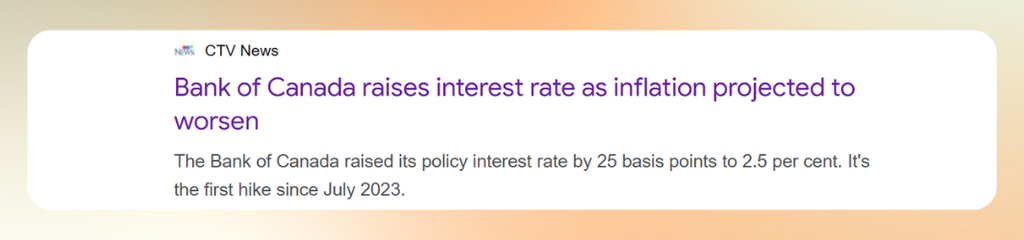
The Bank of Canada has officially increased its key interest rate by 0.25 percentage points, bringing it to 2.5%. This marks the central bank’s first interest rate hike since July 2023.
The decision comes as inflation continues to put pressure on Canadians, with rising energy prices, global uncertainty, and higher business costs creating concerns about the economy.
While Canada’s economy has shown signs of strength, the Bank of Canada believes higher interest rates are necessary to prevent inflation from becoming a bigger problem.
📈 Why Did the Bank of Canada Increase Rates?
The biggest concern is inflation, which currently sits at 3.1%, above the Bank of Canada’s 2% target.
Although rising gasoline and energy prices have been major contributors, the central bank is worried these higher costs could eventually affect everyday goods and services.
For example, when businesses pay more for transportation, fuel, and supplies, they may increase their prices to cover those expenses.
According to the Bank of Canada, approximately 60% of consumer-facing businesses surveyed expect to pass higher costs on to customers over the next 12 months.
By increasing interest rates, the central bank hopes to slow spending and borrowing enough to prevent inflation from spreading further throughout the economy.
⛽ Rising Energy Prices Are Adding Pressure
Global energy prices have increased significantly, largely due to ongoing conflict in the Middle East.
In October, Brent crude oil averaged approximately $124.96 per barrel, around $35 higher than in July.
Higher oil prices don’t just affect what Canadians pay at the gas pump. They can also increase the cost of:
- 🚚 Transportation and shipping
- 🛒 Groceries and everyday essentials
- 🏭 Manufacturing and business operations
- 🏠 Home maintenance and other services
The concern is that if energy prices remain elevated for an extended period, businesses may have no choice but to pass these additional costs on to consumers.
🇨🇦 Canada’s Economy Is Showing Unexpected Strength
Despite ongoing economic uncertainty, Canada’s economy has performed better than expected in certain areas.
According to the Bank of Canada:
- 📊 Second-quarter economic growth: 3.3%
- 📉 Projected third-quarter growth: 2.0%
- 🛍️ Consumer spending: Remains relatively strong
- 🏗️ Business investment: Has improved, particularly in energy, machinery, and equipment
Canadian exports have also benefited from stronger U.S. demand and increased energy production.
However, the central bank expects economic growth to slow toward the end of 2026 as new U.S. tariffs create additional challenges for Canadian businesses.
👷 What About Canada’s Job Market?
Although the economy has shown resilience, Canada’s labour market continues to face challenges.
The unemployment rate has remained around 6.5% in recent months, making it more difficult for unemployed Canadians to find new opportunities.
This creates a challenging situation for the Bank of Canada.
On one hand, higher interest rates may help control inflation. On the other, they can also slow economic activity and make borrowing more expensive for households and businesses.
The central bank must carefully balance these risks when making future interest rate decisions.
🔮 Could Interest Rates Increase Again?
Possibly.
Bank of Canada Governor Tiff Macklem indicated that additional rate increases may be necessary if inflation continues to rise or remains elevated longer than expected.
However, the central bank has also emphasized that it will approach future decisions cautiously given the uncertainty surrounding global energy prices, international trade, and economic growth.
The Bank of Canada expects economic activity to slow in the coming months before improving in 2027.
For now, another rate increase is possible, but not guaranteed. Future decisions will depend heavily on inflation, employment, and overall economic conditions.
🏡 What Does This Mean for Canadian Homeowners and Buyers?
The latest interest rate increase could have different effects depending on your mortgage situation.
🔑 Variable-Rate Mortgage Holders
If you have a variable-rate mortgage, the increase could affect your borrowing costs. Depending on your mortgage structure, your monthly payment may increase, or more of your existing payment may go toward interest rather than principal.
🏠 Fixed-Rate Mortgage Holders
If you’re currently locked into a fixed-rate mortgage, your existing mortgage rate and scheduled payments will generally remain unchanged until your term ends.
However, if your mortgage is approaching renewal, it’s important to review your options, as current fixed rates may differ from what you’re paying today.
💰 First-Time Home Buyers
Higher borrowing costs can affect mortgage affordability and qualification. If you’re planning to purchase a home, understanding your budget and getting pre-approved can help you prepare.
🔄 Homeowners Renewing Soon
Rather than automatically accepting your lender’s renewal offer, consider reviewing available rates, mortgage products, and your future financial plans with a mortgage broker.
💡 In Conclusion
The Bank of Canada’s decision to raise interest rates to 2.5% reflects growing concerns that inflation could remain higher for longer.
While Canada’s economy has demonstrated some strength, rising energy prices, trade uncertainty, and ongoing employment challenges continue to create an unpredictable outlook.
For homeowners and prospective buyers, the key takeaway is to stay informed and make mortgage decisions based on your individual financial situation, rather than reacting to a single interest rate announcement.
Whether you’re buying your first home, renewing your mortgage, or considering refinancing, having a mortgage strategy can help you navigate changing market conditions with greater confidence.
📚 Source: Bank of Canada, October 28, 2026 Interest Rate Announcement and Monetary Policy Report
This article is for general informational purposes only and does not constitute personalized mortgage or financial advice. Mortgage rates and payment impacts depend on individual lender terms and mortgage products.