
Canada’s job market experienced another difficult month in September 2026, with employment falling for the second consecutive month. The latest numbers are raising concerns about the economy and what they could mean for future interest rate decisions.
📊 Canada’s Job Market Takes Another Hit
According to Statistics Canada, the Canadian economy lost 68,000 jobs in September, following a decline of 42,000 jobs in August. That brings the total number of jobs lost over the past two months to 110,000.
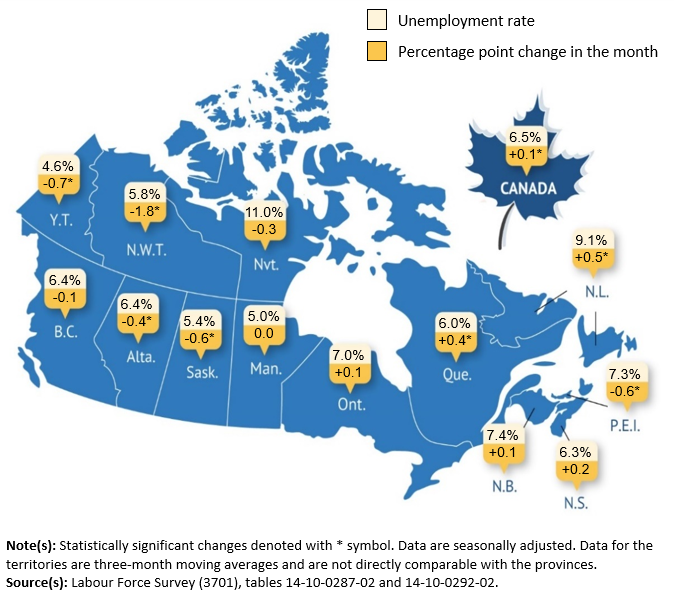
The unemployment rate also increased slightly, rising from 6.4% in August to 6.5% in September, returning to the level recorded at the beginning of 2026. These results came as a surprise to economists, who had expected the economy to add approximately 9,200 jobs in September.
Despite the recent slowdown, employment remains 95,000 positions higher than it was a year ago.

📉 A Sudden Change in Employment Trends
Earlier this year, Canada’s labour market appeared to be gaining momentum. Between April and July, the economy added approximately 181,000 jobs, suggesting that employment conditions were improving.
However, the unexpected declines in August and September have raised questions about whether that growth can continue.
Economists caution that monthly employment figures can fluctuate significantly, meaning two months of job losses do not necessarily indicate a long-term downturn. Still, consecutive declines of this size suggest that the economy may be facing increasing pressure.
🏭 Which Industries Lost the Most Jobs?
Several major industries experienced employment declines in September.
The sectors most affected included:
- 🎓 Educational Services: Employment fell significantly, particularly in Quebec. Changes in international student enrolment may be contributing to weaker demand for workers.
- 🏥 Health Care and Social Assistance: This sector also recorded job losses after previously supporting employment growth.
- 🏭 Manufacturing: Job losses raised concerns about the potential effects of new U.S. tariffs on Canadian businesses.
On the positive side, employment increased in other service industries, including repair and maintenance services, helping offset some of the overall losses.
🏢 Public Sector Employment Falls Sharply
One of the biggest contributors to September’s employment decline was the public sector.
Public sector employment dropped by approximately 70,000 positions during the month. Compared to September 2025, the public sector now has approximately 119,000 fewer employees.
Meanwhile, private sector employment increased slightly, providing some stability during an otherwise challenging month.
Job losses were also spread across both full-time and part-time positions, indicating that the slowdown was not limited to one type of employment.
👥 Young Canadians Hit Particularly Hard
Younger workers experienced some of the largest employment declines in September. Canadians aged 15 to 24 accounted for approximately 48,000 lost jobs, making them one of the most affected groups.
However, the number of young people participating in the labour market also declined, keeping their unemployment rate relatively unchanged at 13%.
Women aged 25 to 54 also faced challenges, with employment falling by approximately 28,000 positions. At the same time, more women in this age group were actively looking for work, suggesting increased competition for available jobs.
📍 Which Provinces Were Most Affected?
Employment changes varied significantly across Canada.
- 📉 Quebec: Lost approximately 49,000 jobs, recording the largest provincial decline.
- 📉 British Columbia: Employment fell by approximately 20,000 positions.
- 📈 Alberta: Added approximately 23,000 jobs, moving against the national trend.
These differences highlight how economic conditions can vary across provinces, even when the national labour market is slowing.
🏦 What Does This Mean for the Bank of Canada?
The latest employment report arrives just weeks before the Bank of Canada’s next interest rate announcement on October 28, 2026.
Employment is one of several important indicators the central bank considers when deciding whether to raise, lower, or maintain interest rates. A weakening job market can suggest that economic activity is slowing, which may reduce the need for additional interest rate increases.
However, the Bank of Canada must also consider inflation, economic growth, and other factors before making its decision.
CIBC senior economist Andrew Grantham believes the recent employment weakness supports a cautious approach. Despite concerns about the impact of U.S. tariffs, he expects the Bank of Canada to keep its policy rate unchanged at its remaining two meetings in 2026.
This remains an economic forecast rather than a confirmed decision.
🏡 What Could This Mean for Canadian Mortgage Rates?
For homeowners and prospective buyers, the latest employment numbers add another important factor to the interest rate outlook.
Here’s why:
- 📉 Weaker employment could reduce pressure for rate hikes. If economic activity continues to slow, the Bank of Canada may have more reason to keep its policy rate steady.
- 🏦 Variable mortgage rates depend on the Bank of Canada’s policy decisions. A rate hold would generally mean no immediate policy-driven change to lenders’ prime rates.
- 📊 Fixed mortgage rates follow a different path. They are influenced largely by bond yields, which respond to inflation expectations, economic conditions, and financial market movements.
Although September’s employment report points to economic weakness, it does not guarantee that mortgage rates will fall.
Borrowers should continue to monitor inflation, bond yields, and upcoming Bank of Canada announcements when evaluating their mortgage options.
🔎 The Bottom Line
Canada’s labour market is showing signs of weakness after losing 110,000 jobs over August and September combined.
While employment remains higher than a year ago, consecutive monthly declines, particularly in the public sector, manufacturing, and among younger workers, suggest that economic conditions are becoming more challenging.
The upcoming Bank of Canada announcement on October 28 will be especially important as policymakers balance slowing employment against ongoing inflation risks.
For Canadians buying a home, renewing a mortgage, or considering refinancing, staying informed about these economic changes can help support better financial decisions.
Do we recommend locking in your variable rate mortgage at this time?
☐ Yes
☐ No
✅ Maybe
We’re taking a case-by-case approach.
Canada’s recent job losses could give the Bank of Canada more reason to hold rates steady. However, inflation concerns remain, and both fixed and variable rates are facing upward pressure.
For some homeowners, locking into a lower fixed rate could make sense, while others may benefit from staying variable.
Our recommendation: Let’s compare your options before making a decision. The best choice depends on your current rate, mortgage terms, and financial goals.