
Canada’s labour market delivered another positive surprise in July, adding 75,000 jobs while the national unemployment rate dropped to 6.4%, its lowest level in two years.
The latest figures from Statistics Canada point to continued improvement in employment after gains in both May and June.
📈 Canada’s Labour Market Strengthens
Employment increased by 75,000 jobs, or 0.4%, in July, with gains spread across both full-time and part-time positions.
One of the strongest sectors was wholesale and retail trade, which added approximately 21,000 jobs during the month.
Employment also increased among Canadians aged 25 to 54, with much of the growth coming from women in this age group.
Overall, Canada has now added approximately:
👥 181,000 jobs since April
📅 196,000 jobs compared to one year ago
Three consecutive months of employment gains could be an encouraging sign that Canada’s labour market is beginning to regain momentum.
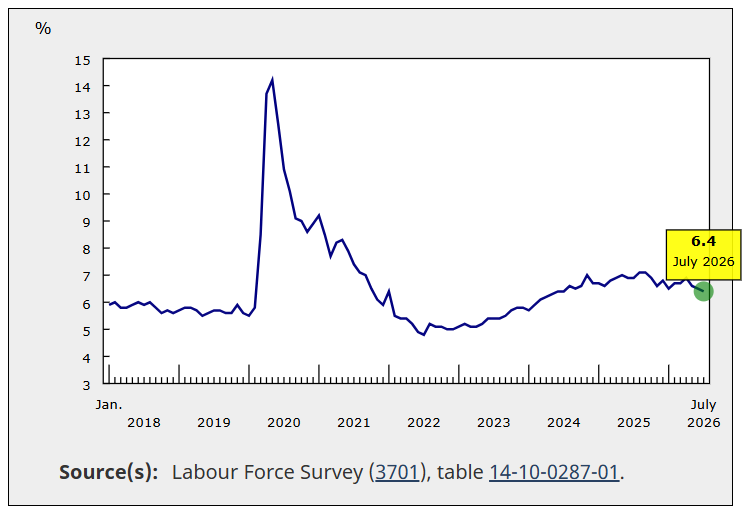
Source: Statistics Canada, Labour Force Survey, Chart 2: “Unemployment rate falls for the third consecutive month to reach a two-year low of 6.4% in July.” Data from Table 14-10-0287-01.
🏙️ Ontario Leads Job Growth
Ontario recorded the largest employment increase among the provinces in July, adding approximately 52,000 jobs, or 0.6%.
Much of Ontario’s growth came from the professional, scientific and technical services sector.
Other provinces also recorded gains:
📍 British Columbia: +18,000 jobs
📍 Manitoba: +5,900 jobs
📍 Nova Scotia: +4,600 jobs
The broad-based gains suggest that July’s improvement wasn’t limited to just one part of the country.
💰 Wage Growth Continues to Cool
While employment strengthened, wage growth slowed.
Average hourly wages were up 2.8% year-over-year in July, compared with 3.3% in June.
According to BMO chief economist Douglas Porter, this represents the slowest pace of wage growth in four years and brings wage increases closer to trends seen before the pandemic.
Slower wage growth could also help reduce inflationary pressure, an important factor for the Bank of Canada when considering future interest rate decisions.
🏦 What Could This Mean for Interest Rates?
The stronger-than-expected jobs report shows that Canada’s economy may be holding up better than anticipated.
At the same time, the combination of a 6.4% unemployment rate and cooling wage growth suggests the labour market may not be strong enough on its own to create significant inflation pressure.
For the Bank of Canada, this creates a mixed picture. Stronger employment could reduce the urgency for lower rates, while softer wage growth and remaining slack in the labour market could give the Bank room to remain patient.
Future rate decisions will likely depend heavily on inflation, economic growth and how ongoing trade uncertainty affects Canadian businesses and consumers.
⚠️ Trade and Tariff Risks Remain
Despite July’s positive employment numbers, Canada continues to face uncertainty surrounding its trade relationship with the United States.
Businesses have so far shown signs of adapting to trade-related challenges, but the possibility of additional U.S. tariffs could put pressure on Canadian industries in the months ahead.
Trade discussions between Canada and the U.S. remain important, particularly for sectors such as steel and aluminum, while talks related to the Canada-United States-Mexico Agreement are expected to resume in the fall.
🔎 The Bottom Line
July’s labour report was stronger than expected.
Overall, the numbers suggest Canada’s labour market is moving in a healthier direction. However, slower wage growth, remaining unemployment and uncertainty surrounding U.S. trade policy mean there are still risks ahead.
For borrowers and homebuyers, the report is another important piece of the puzzle when it comes to the Bank of Canada and the future direction of interest rates.