
Canada’s labour market continued to show signs of improvement in June, with the economy adding 18,000 jobs and the national unemployment rate edging down to 6.5%.
The latest figures suggest that hiring momentum carried into the start of summer, following a much stronger increase in employment in May.
📊 June Job Growth Beats Expectations
The June results came in slightly stronger than many economists had anticipated.
Analysts had expected approximately 10,000 new jobs and an unemployment rate of 6.6%. Instead, employment increased by 18,000 positions while the jobless rate declined to 6.5%.
That follows a significant increase of nearly 88,000 jobs in May, helping the labour market regain some ground after a difficult start to 2026.
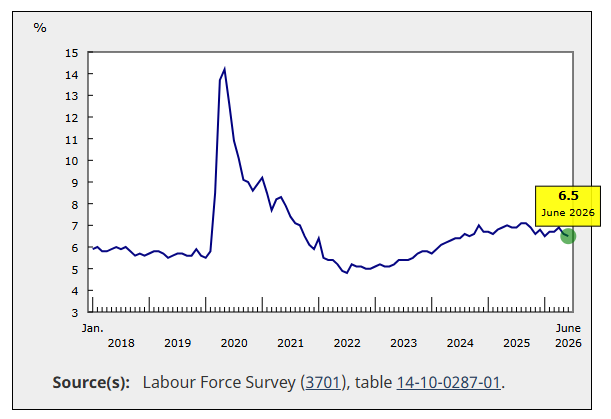
Source: Statistics Canada(Graeme Bruce/CBC)
🕒 Part-Time Work Drove Much of the Increase
A large share of June’s employment growth came from part-time positions.
Hiring was particularly concentrated in:
🍽️ Accommodation and food services
🛍️ Wholesale and retail trade
While the overall increase is encouraging, some economists remain cautious. Because much of the hiring occurred in part-time and service-related industries, the gains may not necessarily point to broad-based strength across the economy.
Some of the increase could also reflect temporary or seasonal hiring tied to major summer activity, including the World Cup.
🏭 Manufacturing Continues to Face Pressure
Not every sector saw improvement.
Manufacturing employment declined by approximately 17,000 jobs in June, adding to ongoing weakness in the industry.
The sector has now lost roughly 61,000 positions since its recent peak in January 2025, with continued trade uncertainty and U.S. tariffs creating challenges for Canadian manufacturers.
👩💼 Youth Employment Shows Improvement
There was more positive news for younger Canadians.
Employment among workers aged 15 to 24 increased by 33,000 positions, helping bring the youth unemployment rate down by 0.7 percentage points to 12.7%.
Although that marks an improvement, youth unemployment remains above the 10.8% pre-pandemic average recorded between 2017 and 2019.
🎓 A Better Summer Job Market for Students
Students returning to school in the fall also experienced a stronger start to the summer job season compared with last year.
The unemployment rate for returning students fell to 15.3%, down 2.1 percentage points from June 2025.
Most of the employment gains for returning students were concentrated in:
🛍️ Retail trade
🍽️ Accommodation and food services
🎭 Information, culture and recreation
Despite the year-over-year improvement, student unemployment remains above the pre-pandemic average of approximately 13%.
💰 Wage Growth Picks Up
Average hourly wages for permanent employees increased 3.7% year over year in June, accelerating from 3.2% in May.
This is an important figure because wage growth is closely watched when assessing inflation pressures. Stronger wage gains can support household spending, but they may also contribute to persistent inflation if labour costs continue rising.
📉 The Bigger Picture
The latest report suggests Canada’s labour market has regained some momentum after a challenging beginning to the year.
Canada lost a net 112,000 jobs during the first four months of 2026, making the employment gains in May and June an important improvement.
However, overall employment growth remains relatively modest, and some economists caution that the decline in unemployment may also be influenced by slower population growth rather than a major surge in hiring.
🏦 What Could This Mean for the Bank of Canada?
The June employment report is unlikely to dramatically change expectations for the Bank of Canada’s next interest rate decision.
While the lower unemployment rate and stronger wage growth suggest some resilience in the economy, the overall report remains mixed. Much of the job growth came from part-time work, while manufacturing continued to lose positions.
With both positive and negative signals in the data, the Bank of Canada will likely continue weighing labour market conditions alongside inflation, economic growth, and broader trade risks when deciding its next move on interest rates.
Do we recommend locking in your variable rate mortgage at this time?
☐ Yes
✅ No
☐ Maybe
We don’t recommend locking in at this time. While June’s jobs report showed some improvement, the gains were modest and largely driven by part-time work.
The data does not suggest enough economic strength to create significant upward pressure on interest rates, so staying variable remains the more attractive option for now.
That said, locking in should depend on your comfort level, timeline, and overall strategy, so reach out to us if you have questions and we’ll walk through it together.