
📉 July Sees Job Losses, Especially for Youth and Full-Time Workers
Canada’s job market took a hit in July, losing approximately 41,000 jobs, according to Statistics Canada. The majority of those losses were in full-time positions and private-sector roles.
While the unemployment rate stayed at 6.9%, it wasn’t necessarily good news. The rate held steady only because fewer people were actively looking for work — not because more jobs were available.
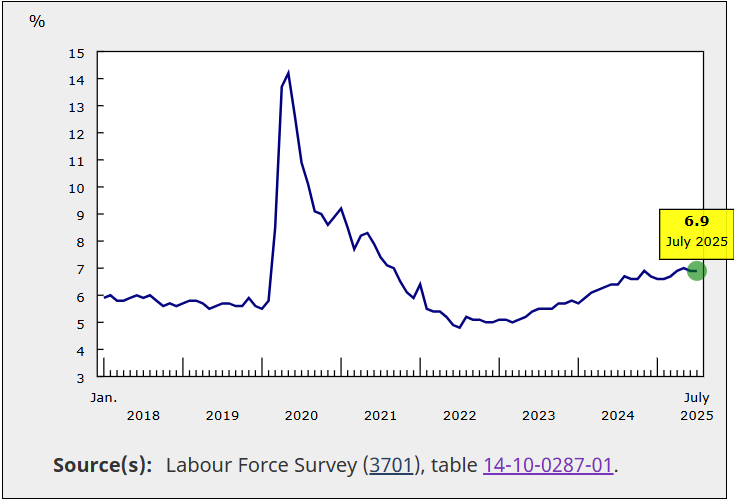
Source: Statistics Canada. (2025, August 8). The unemployment rate unchanged at 6.9% in July [Chart 2]. The Daily. Labour Force Survey, July 2025
📊 A Turnaround from June’s Job Surge
This downturn follows June’s surprise gain of 83,000 jobs, making July’s results feel like a sharp reversal. Economists had actually forecasted modest job growth, not losses.
Doug Porter, BMO’s Chief Economist, called the report the weakest in three years, noting that total hours worked also declined by 0.2%, signaling a slow start to Q3.
🧑🎓 Young Canadians Hit the Hardest
Young Canadians aged 15 to 24 were disproportionately impacted, losing 34,000 jobs last month. Their employment rate dropped to 53.6%, marking the lowest since 1998 (excluding the pandemic years). It’s clear the summer job market has been especially challenging for youth.
🏗️ Industry Breakdown: Where Jobs Were Lost (and Gained)
Several key industries faced significant job losses in July:
- Information, Culture & Recreation: -29,000 jobs
- Construction: -22,000 jobs
On the flip side, a few sectors saw modest gains:
- Transportation & Warehousing: +26,000 jobs (first gain since January)
- Manufacturing: +5,300 jobs (though still down 9,400 year-over-year)
Many of these industries are sensitive to U.S. trade policies, especially tariffs, which continue to impact hiring and operations.
🧾 Layoffs, Long-Term Unemployment, and Wages
Despite the job losses, the layoff rate remained unchanged from last year at 1.1%.
However, long-term unemployment is on the rise. Nearly 1 in 4 job seekers (23.8%) have been out of work for 27 weeks or more, the highest level seen since 1998 (excluding the pandemic).
📈 On a brighter note, average hourly wages rose by 3.3% compared to last year, showing a slight uptick from June.
🏦 What This Means for Interest Rates
The Bank of Canada is closely watching these job numbers as it prepares for its next interest rate decision on September 17.
With the central bank keeping its policy rate at 2.75% for now, some economists, including CIBC’s Andrew Grantham, say the weaker labour data could pave the way for a rate cut in September.
Before then, the Bank will also review:
- August job data
- Two inflation reports
- Quarterly GDP update
The labour market is showing signs of stress, especially for young workers and those in full-time private-sector roles. While wages are rising, fewer job opportunities and long-term unemployment are raising red flags.
👀 All eyes are now on the Bank of Canada’s next move, which could offer some relief for borrowers if a rate cut is announced.
📲 Stay informed with the latest updates on Canada’s economy, employment, and mortgage trends. Follow us for more insights!