
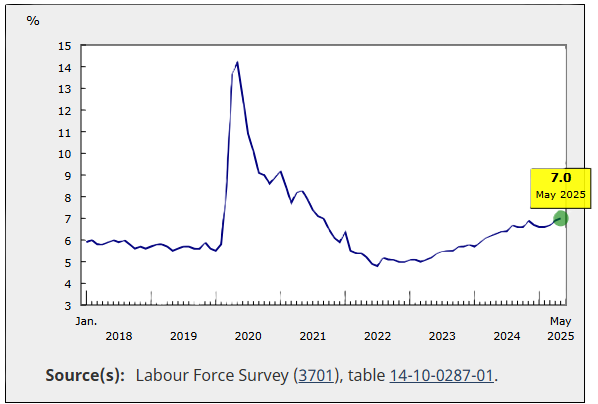
Canada’s unemployment rate climbed to 7% in May, marking the highest level seen since 2016 outside of the pandemic years. According to Statistics Canada, the country added only 8,800 jobs last month — a small gain that highlights just how weak the job market has become. Since January, there’s been little to no net employment growth, and this latest data reinforces concerns about economic momentum.
⚖️ A Closer Look at the Numbers
Digging into the details, the job market appears to be stuck in a tug-of-war. While full-time employment rose by 58,000, nearly all those gains were cancelled out by the loss of 49,000 part-time jobs. Some sectors bounced back, like wholesale and retail trade, which added 43,000 jobs after springtime declines. There were also small improvements in information, culture, and recreation.
However, other key sectors struggled. The public administration sector shed 32,000 jobs in May, largely due to the end of temporary roles tied to April’s federal election. The accommodation and food services, as well as transportation and warehousing industries, also reported job losses. Meanwhile, manufacturing employment fell by 12,200 jobs, continuing a concerning downward trend. Cities like Windsor, Oshawa, and Toronto are being hit particularly hard, facing an “uncertain economic climate” tied to ongoing tariffs on motor vehicles and parts. In fact, Windsor’s jobless rate surged to nearly 11% in May — the highest in the country.

💸 Wages Steady, But Job Hunts Get Tougher
On the wage front, average hourly earnings rose 3.4% in May — the same pace as April. But despite stable wage growth, Canadians are finding it tougher to land a job. The average duration of unemployment has increased to 21.8 weeks, up from 18.4 weeks a year ago. The situation is especially challenging for young Canadians: 1 in 5 students aged 15–24 who planned to return to school in the fall were unemployed in May — the highest non-pandemic youth jobless rate since 2009.
🧭 How This Impacts Interest Rates
With job growth stalling and unemployment rising, many economists now believe the Bank of Canada may be preparing for further rate cuts. Although the central bank held its key rate steady this week, the signs of growing slack in the labour market are hard to ignore. Experts from TD, BMO, and CIBC all agree: the combination of weak job data and slower economic activity strengthens the case for additional easing, possibly as early as July.
As BMO’s Doug Porter put it, “The main point is that slack is still growing in the labour market.” That slack may be enough to convince the Bank that further stimulus is needed.
So, what does all of this mean for you? If the Bank of Canada does move forward with more rate cuts, it could translate into lower borrowing costs — including for mortgages. For homeowners looking to renew, refinance, or buy, a softer rate environment might create opportunities to lock in better terms. But with economic uncertainty still looming, having a clear mortgage strategy is more important than ever.
Go Approval is here to help you understand your options and make confident decisions. Whether you’re renewing soon or thinking about refinancing, we’re happy to walk you through it.