
Global ripple effects, investor fears, and U.S. economic uncertainty are pushing Canadian rates back above 4% — here’s what homeowners need to know.
After briefly falling below 4%, most five-year fixed mortgage rates in Canada are back on the rise. Experts say they may stay elevated for a while — and the reasons have more to do with what’s happening in the U.S. than here at home.
🔄 What’s Causing the Uptick in Rates?
Not long ago, fixed rates dropped sharply as bond yields fell, partly due to concerns over U.S. tariffs. But that dip didn’t last.
Canadian five-year fixed mortgage rates are closely linked to the country’s five-year government bond yields — which themselves are heavily influenced by the U.S. 10-year Treasury yield. So when the U.S. market moves, Canadian rates often follow.
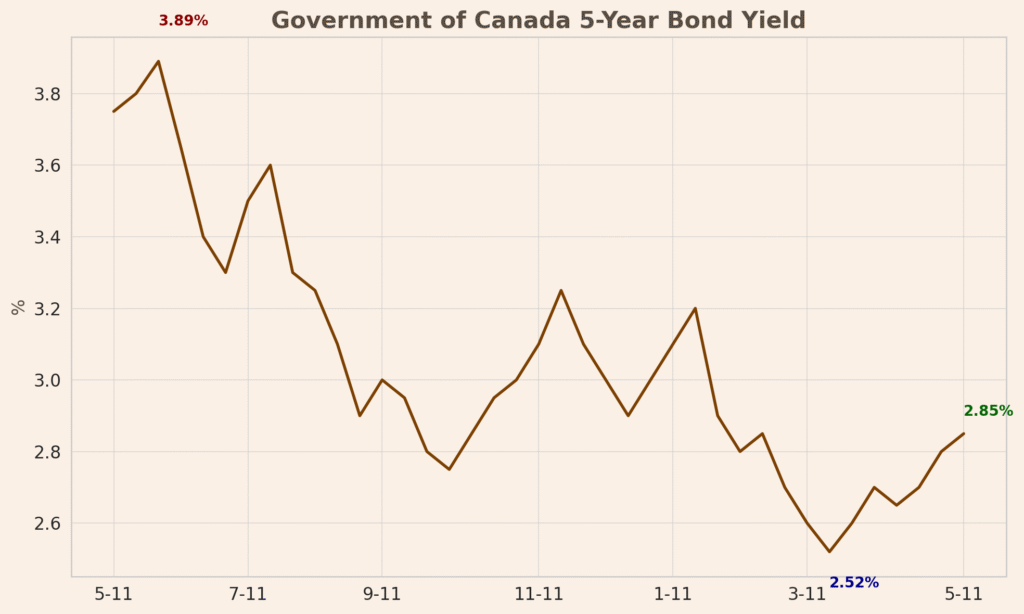
In early April, the U.S. 10-year Treasury yield dropped below 4%. Now it’s back above 4.5%. In response, Canada’s five-year bond yield rose from about 2.5% to 2.85%, dragging fixed mortgage rates upward along with it.
Some of the big banks are already adjusting. RBC and CIBC have raised their five-year fixed rates by roughly 10 basis points. TD made similar moves. Scotiabank, however, took the opposite route — slashing some of its short-term digital mortgage rates by as much as 90 basis points.
🌍 Why U.S. Markets Are Driving Canadian Mortgages
Although these changes are happening in Canada, the root causes lie largely in U.S. economic developments. Bond yields and mortgage rates are being influenced by:
- U.S. inflation reports
- Expectations for interest rate cuts
- Concerns over stagflation (a mix of high inflation and weak growth)
- Investor sentiment and confidence
- Foreign demand for U.S. Treasuries
Some investors are even speculating that countries like China may be buying less U.S. debt and turning to gold instead. If that’s true, it forces the U.S. government to make its bonds more appealing — often by raising yields.
Also in play: about $7 trillion in U.S. Treasuries are maturing this year. That’s a lot of refinancing, and it could drive yields even higher if investor demand doesn’t keep up.

🏡 What Does This Mean for Canadian Homeowners?
With all this volatility, even the experts admit it’s tough to predict what comes next. That includes U.S. Federal Reserve Chair Jerome Powell, who’s been cautious in his messaging around future rate moves due to the unknown impact of tariffs and other global uncertainties.
So, what should Canadian borrowers do?
If you prefer stability, a five-year fixed rate might be the safest option right now. Locking in your rate can give you peace of mind and predictability in your monthly payments — especially if you’re risk-averse.
But there’s a case to be made for going variable, too.
🔮 Could Variable Rates Drop Soon?
Some experts believe variable rates may start to fall again soon — possibly even as early as June.
Sal Guatieri, a senior economist with BMO, expects inflation in Canada to stay near the Bank of Canada’s 2% target, which could pave the way for rate cuts. He’s forecasting three rate cuts this year.
Mortgage broker Ron Butler agrees. He believes fixed rates could dip back into the 3% range later this year — at which point variable borrowers could choose to lock in.
“If you go variable now and rates fall, you benefit right away,” Butler says. “And if fixed rates drop below 4% again, you can always switch to a fixed term with your lender.”
Canadian fixed mortgage rates are rising again — not because of local economic data, but because of global uncertainty, especially in the U.S.
Global uncertainty doesn’t have to mean personal stress. At Go Approval, we’ll help you understand how rising rates impact you — and create a mortgage strategy that protects your peace of mind.