
As Canada closed out 2024, the inflation rate dipped to 1.8% in December, marking its lowest point since early 2021. For many Canadians, this news comes as a hopeful signal that relief might finally be on the horizon in the form of lower borrowing costs. But what does this mean for the average household, and how likely is the Bank of Canada to cut rates this month? Let’s break it down in plain language.
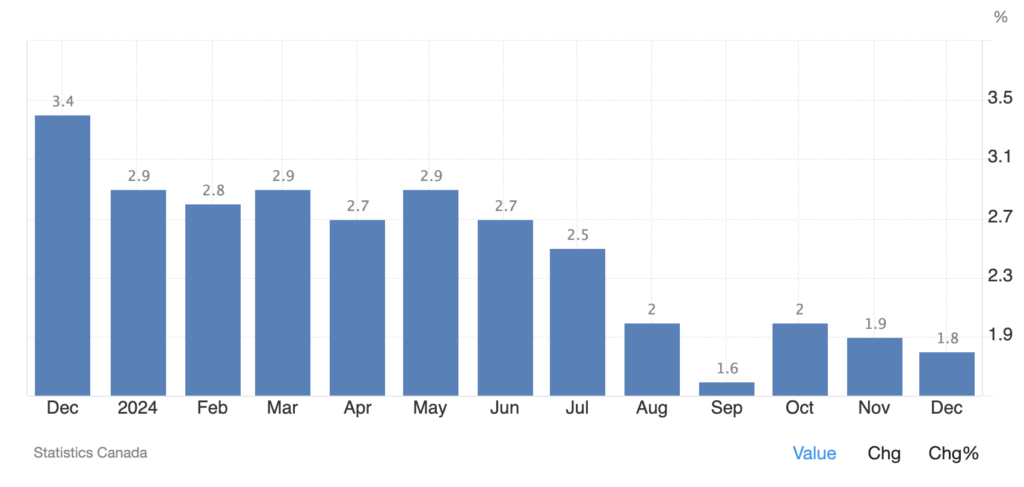
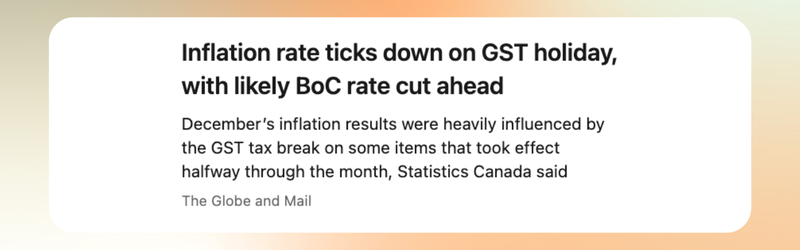
Inflation, which measures how much the cost of living rises over time, has been a hot topic over the past two years. Canadians have been feeling the pinch as higher prices for food, housing, and essentials stretched budgets thin. But now, with inflation easing, we’re beginning to feel like there could be some light at the end of the tunnel. The December slowdown was partially due to a temporary GST/HST holiday introduced by the federal government, which gave consumers a bit of breathing room during the holidays.
What are economists saying?
Economists across Canada are divided about whether the Bank of Canada will cut interest rates during its next announcement, but many agree that the odds have increased. Some, like those at Desjardins, argue that a modest 0.25% cut makes sense given the current environment. Others, like Scotiabank, are more cautious, pointing out that underlying inflation pressures remain too strong for aggressive action.
RBC noted that while mortgage interest costs are finally slowing, they still make up about 30% of total inflation growth. This means that even though inflation is cooling, the cost of owning a home is still weighing heavily on many Canadians.
As we wait for the Bank of Canada’s next announcement, one thing is clear: the drop in inflation to 1.8% is a step in the right direction. While economists may debate the exact timing and size of rate cuts, the overall trend is giving Canadians reason to feel cautiously optimistic.
On The Impact On next Week’s Bank of Canada’s Rate Decision:
- TD (Leslie Preston): “…core inflation pressures have picked up over the past three months, suggesting that inflation readings are likely to move up a bit in the months ahead. This will give the Bank of Canada reason to adopt a more gradual pace of interest rate cuts this year. We expect a quarter point cut at every other decision in 2025.”
- BMO (Douglas Porter): “We believe that the heavy overhang of trade uncertainty—possible U.S. tariffs—overrides almost all else. As a result, we suspect that today’s reading is just good enough to allow the Bank of Canada to trim next week, for risk management purposes.”
- CIBC: “through the volatility it still appears that core price pressures are low enough, and the economy weak enough, to justify a 25bp reduction in interest rates from the Bank of Canada next week.”
- Scotiabank (Derek Holt): “I don’t believe that the BoC should cut but they may well take the easy route in what’s priced…The BoC is already at or very close to a neutral rate by contrast to the Federal Reserve…Therefore, what’s the rush to cut after 175bps of cuts to date? I know one thing for sure: I wouldn’t cut at this point while leaving all options open going forward.”
- Desjardins: “With the inauguration of President Donald Trump yesterday, downside risks to the economy abound, not least from the threat of a 25% tariff being introduced on February 1. This economic uncertainty reinforces our call the next rate cut in January is likely to be a modest 25 basis points, and that subsequent rate reductions should be of a similar magnitude.”
- National Bank: “…we believe that the Bank of Canada should continue to ease monetary policy by cutting its policy rate by 25 basis points next week. This would give us a little more hope of seeing economic growth above potential assuming Canada is able to avoid a tariff war with our largest trading partner.”
For now, the best move is to stay informed and, if possible, consult with a mortgage broker or financial advisor to see how potential rate cuts could impact your finances. At Go Approval, we’re here to guide you through these changes and help you make the most of the opportunities they bring.
Let’s hope 2025 continues to bring positive news for the economy and Canadian households. Stay tuned for updates—we’ll be keeping a close eye on what the Bank of Canada decides next.