
In the latest monetary policy update that surprised no one, the Bank of Canada has once again opted to hold its benchmark interest rate steady at 5%. Statistics Canada’s recent announcement highlighted several factors contributing to the inflation slowdown. Notably, there was a significant easing in the prices of groceries, alongside reductions in the cost of cellular services and internet access.
This easing comes as a relief, particularly when offset against a minor year-over-year increase in gas prices of 0.8%, following a 4% decrease in January.
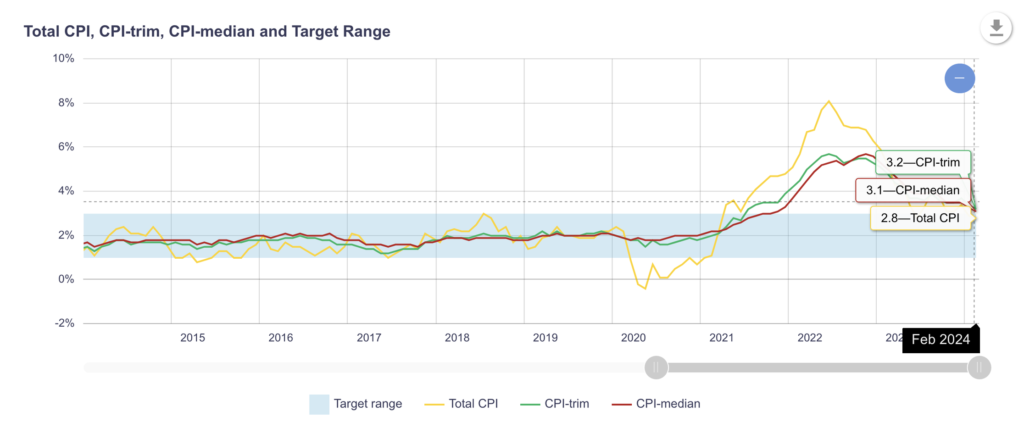
Contrary to the expectations set by analysts for an acceleration to 3.1% in February, following a 2.9% increase in January, the actual figures presented a different story. This deceleration in inflation is seen as “unambiguously good news” by experts, providing the Bank of Canada with a more dovish stance ahead of its April meeting.

Bank of Canada’s Response
The cooling inflation comes as the second consecutive month where figures have remained within the Bank of Canada’s target range of 1% to 3%. Moreover, it’s running below the central bank’s projections, which anticipated a CPI of 3.2% in the first quarter.
Significantly, the preferred measures of core inflation, which are closely watched by the Bank of Canada for policy decisions, also showed a decline. Both CPI-median and CPI-trim recorded drops, reaching their lowest in over two years, signaling a potential shift towards interest rate cuts.
Following the release of the inflation data, the betting odds for a rate cut in June soared, with money markets now pricing in a 75% chance for a 25 basis point cut. This is a notable increase from the 50% chance before the data was unveiled. The central bank’s next rate decision, scheduled for April 10, is highly anticipated, as it precedes the March inflation figures.
Impact on Grocery Prices and More
A closer inspection of February’s data reveals a broad-based slowdown in the growth of grocery prices, a welcome change for Canadian consumers. With increases in food prices being a significant concern in recent times, the slowdown in grocery price inflation, particularly in meat, dairy, and fresh fruits, is a positive development. Despite this slowdown, it’s important to note that food prices have surged by 21.6% from February 2021 to February 2024, underlining the longer-term trend of rising food costs.

The decrease in costs for cellular plans and internet services further contributed to the overall easing of inflation, offering some respite to consumers facing elevated prices across various sectors.
Looking Ahead
As Canada witnesses a cooling in inflation, the path seems to be clearing for the Bank of Canada to adopt a more dovish approach, potentially leading to interest rate cuts starting in June. This development is keenly awaited by both consumers and investors, as it could have wide-ranging implications for the economy. With the Bank of Canada’s next meeting on the horizon, all eyes will be on their decision, which could mark the beginning of a new phase in Canada’s monetary policy amidst the evolving economic landscape.