
Recent trade tensions between Canada and the United States are creating new uncertainty for the economy, and one area that could be affected is fixed mortgage rates.
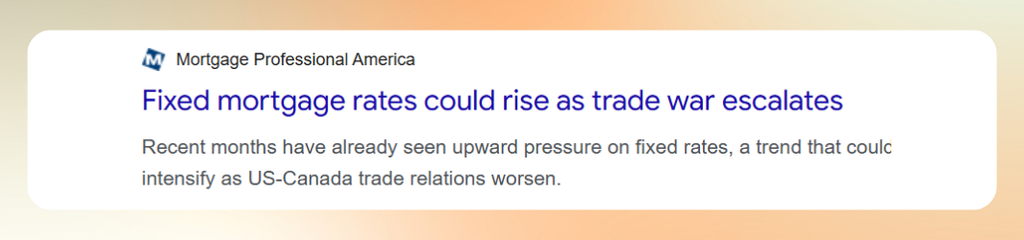
While the Bank of Canada is widely expected to keep its key interest rate unchanged for now, experts say fixed rates could continue facing upward pressure as bond markets react to inflation concerns, government borrowing, and the growing trade dispute.
🏦 The Bank of Canada May Stay on Hold
The Bank of Canada is expected to continue its cautious approach by holding its benchmark interest rate steady at its upcoming meeting.
That means variable mortgage rates are unlikely to change in the immediate future, since they are more directly influenced by the Bank of Canada’s policy rate. However, the outlook for fixed rates is becoming less certain because they are tied more closely to bond yields than central bank decisions.
📊 Why Fixed Rates Could Move Higher
Fixed mortgage rates are largely influenced by Government of Canada bond yields, particularly the 5-year bond.
In recent months, bond yields have gradually increased, and economists say rising long-term interest rates in the United States could spill over into Canada as well.
Several factors are contributing to that pressure:
- 🇺🇸 Higher U.S. long-term bond yields
- 💰 Concerns surrounding massive U.S. government borrowing
- 🤖 Increased corporate borrowing linked to AI investment
- 📈 Ongoing inflation worries in both Canada and the U.S.
When bond yields rise, lenders often respond by increasing fixed mortgage pricing.
🔥 Inflation and Tariffs Are Connected
One of the biggest concerns surrounding the trade war is inflation.
Tariffs can increase the cost of imported goods, which may eventually lead businesses to pass those higher costs onto consumers. If inflation begins climbing again, bond markets could react by pushing yields even higher, creating additional pressure on fixed mortgage rates.
However, this is still a developing situation, and economists are watching closely to see how long these tariffs remain in place and how much of the added cost actually reaches consumers.
⚖️ Could Variable Rates Benefit Instead?
Interestingly, the trade war creates two possible outcomes for interest rates.
On one hand, tariffs could fuel inflation, which would be more supportive of higher bond yields and potentially higher fixed rates.
On the other hand, if the trade dispute significantly weakens Canada’s economy, the Bank of Canada could eventually consider lowering interest rates to stimulate economic activity. That scenario could benefit variable-rate borrowers over time.
For now, economists generally see rate cuts as unlikely in the near term, but they also believe additional rate hikes have become much less likely as economic uncertainty increases.
🇨🇦 What Happened With the New Tariffs?
Trade negotiations between Canada and the U.S. recently broke down, leading to a new round of tariffs.
The United States imposed 50% tariffs on approximately $27.6 billion worth of Canadian goods, affecting a wide range of products. In response, Canada announced matching counter-tariffs ranging from 15% to 50% on selected American imports beginning September 8.
The new measures affect industries including:
- 🧀 Dairy
- 🏗️ Building and industrial materials
- 📱 Electronics
- 🚜 Agricultural equipment
- 🏠 Appliances
- 🏭 Steel and aluminum products
While the tariffs are expected to create challenges for businesses and consumers, economists note that the immediate economic impact may be more limited than the broader blanket tariffs threatened during earlier stages of the trade conflict.
💼 How Could This Affect Canadians?
The biggest issue right now is uncertainty.
Businesses may delay investments, consumers could face higher prices on certain goods, and financial markets are likely to remain sensitive to developments between Canada and the U.S.
For mortgage borrowers, that means the outlook is becoming increasingly split:
- Variable rates: Likely to remain stable in the short term if the Bank of Canada continues holding rates.
- Fixed rates: Could experience additional upward pressure if bond yields continue rising.
Neither outcome is guaranteed, but the direction of inflation, bond markets, and the trade dispute will all play an important role in determining where mortgage rates head next.
🏠 What This Means for Homeowners
If you’re shopping for a mortgage or approaching your renewal, it’s important to remember that fixed and variable rates are responding to different economic forces right now.
Rather than focusing only on headlines, the better approach is to consider your financial goals, comfort with payment changes, and long-term mortgage strategy. With markets changing quickly, choosing between fixed and variable should be based on your individual situation rather than trying to predict every economic move.
Do we recommend locking in your variable rate mortgage at this time?
☐ Yes
☐ No
✅ Maybe
For most variable-rate borrowers, we don’t think there’s a reason to panic or rush to lock in. While fixed rates could face upward pressure from rising bond yields, we don’t expect variable rates to move higher anytime soon.
However, if you’re currently in a higher variable rate and have the opportunity to lock into a competitive fixed rate, it may be worth reviewing the numbers.
We still see value in staying variable for many borrowers. But with fixed rates and variable rates being influenced by different factors right now, the right decision depends on your current rate, the fixed rate being offered, and your comfort level with potential fluctuations.
Before making a change, reach out to us and we can compare the options based on your specific mortgage.