
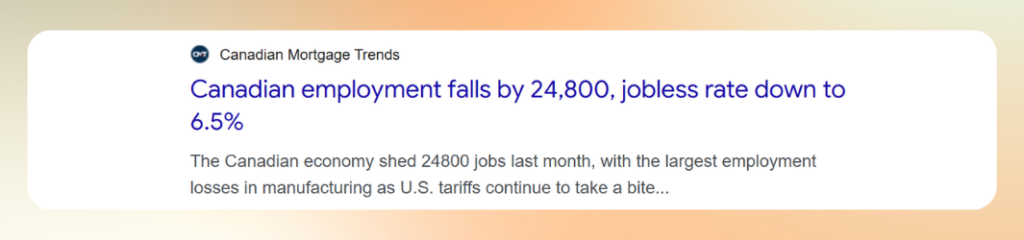
Canada lost 24,800 jobs last month, surprising economists who were expecting modest job growth. The biggest hit came from manufacturing, as U.S. tariffs continue to weigh on export-focused industries.
📉 Employment Fell, But Unemployment Also Dropped
Despite job losses, Canada’s unemployment rate fell to 6.5%, down from 6.8%.
Why?
Fewer people were actively looking for work, which lowered the overall unemployment rate.
The labour force participation rate dropped to 65%, its lowest level in months.
🏭 Manufacturing Under Pressure
Manufacturing was the hardest-hit sector:
- 51,000 manufacturing jobs lost since January 2025
- Ontario saw the largest provincial decline, losing 67,000 jobs
- U.S. tariffs have been especially damaging to Ontario’s auto sector
As an example, 500 workers were laid off in Oshawa after General Motors shut down one production shift.
🚪 More Workers Considering an Exit
New survey data suggests trade tensions are affecting worker confidence:
- 5.4% of core-age workers in U.S.-dependent industries plan to leave their jobs within the next year
- That’s up 1.5 percentage points from last year
- Other industries saw a smaller increase of 0.7 percentage points
These roles have traditionally offered full-time hours and higher-than-average wages, making this shift notable.
👥 Fewer Canadians in the Workforce
Canada’s labour force is shrinking for structural reasons:
- 12.4 million people aged 15+ were not working or looking for work
- That’s a 2.7% increase from a year ago
- Aging demographics and tighter immigration policies are key drivers
- Youth aged 15 to 24 were the only group whose population declined year over year
💸 Wage Growth Is Cooling
Wage pressures continued to ease in January, with average hourly wage growth for permanent employees slowing to 3.3%, down from 3.7% the month before. This cooling trend suggests the labour market is losing momentum, which may help ease inflation pressures over time and gives policymakers more room to stay patient.
📊 What This Means for the Economy
Economists described the report as weak, especially after the stronger employment gains seen late in 2025. Recent data suggests economic momentum is fading, with industry-level GDP figures pointing to a roughly 0.5% contraction in the fourth quarter. Combined, softer job growth and slowing activity signal an economy that is cooling, not rebounding.
🏦 Implications for Interest Rates
The labour market remains a key focus for the Bank of Canada, but this report alone is unlikely to trigger immediate rate changes. Policymakers have warned that cutting rates during a supply-side shock could reignite inflation. As a result, most economists expect rates to remain on hold for now, with additional economic weakness likely required before rate cuts are seriously considered.
🤔 Does Victor recommend locking in your Variable rate mortgage at this time?
☐ Yes
☐ No
✅Not Yet
Economic data matters when it comes to interest rates and mortgage planning. At Go Approval, we help you understand what’s changing and what to do next.
📲Reach out anytime.